I Finally Got Covid

It's weird to finally get COVID-19, seeing as how it's June 2024. It was a good run, while it lasted. Having gotten the original vaccination and every available booster they would let me take, it hasn't been anything other than my standard summer cold. What's my standard summer cold? Two days of agonizing nasal congestion that prevents me from getting any meaningful amount of sleep and then 5-7 days of a rib-cracking cough.

Which, is what I'm going through now.

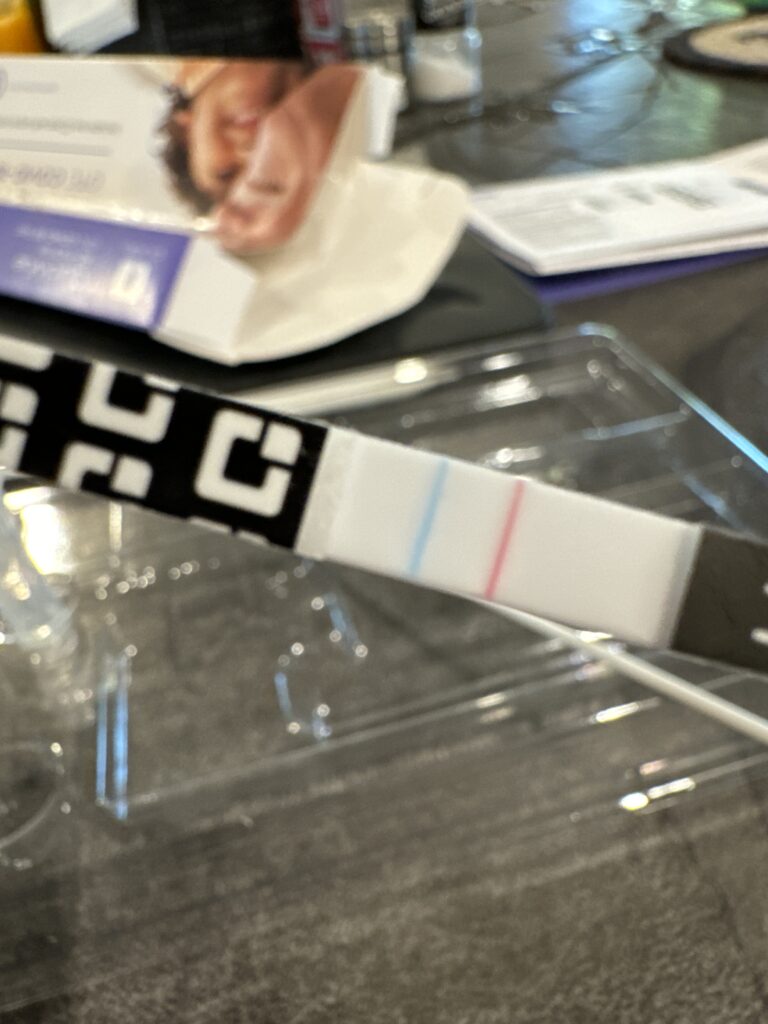
A COVID-19 test strip showing a positive result.

Yes, as soon as I started feeling symptons I masked when I went out. I didn't even think to test until Kat suggested it. That probably cost me two days of knowing, but...I'm not sure what I would have done different. Maybe I would have tried to get one of the anti-virals? I don't know.

I have noticed that trying to keep my blood sugar down has been...challenging to say the least. I'm having trouble finding the studies, but the gist is that the inflamatory response impacts how the body uses insulin which can lead to higher blood sugar. CAN CONFIRM! Keeping my sugar down has been tough and super frustrating for me because I typically has this very dialed in and completely under control. Very, very frustrating...

But, even though I finally did get COVID, I feel confident that my case is relatively mild is thanks to vaccines. Fuck yeah, science!

Six-ish Years of Living with Diabetes and Apple Rumors

Time flies when you’re having fun, rite? It’s been approximately six years since I was diagnosed with Type 1 Diabetes. Fun fact, I wasn’t correctly diagnosed at first but I’m backdating this. There is much to say about how many people are misdiagnosed with Type 2, but that’s for smarter people. Type 1 diabetes is a chronic disease I’ll most likely have for the rest of my life and if I don’t treat it with medication (insulin) I will die. Before the discovery of insulin and creating ways for diabetics to get insulin into their bodies, diabetes was a death sentence. I feel very fortunate that today diabetes, while chronic and potentially deadly, is entirely manageable.

For me, and yes this is specific to me because while the basics of diabetes is the same for everyone, how diet, exercise, and medication impact individuals with vary wildly, I have focused on diet and exercise. I’m still dependent on insulin to stay alive, but I do try and keep my insulin intake on the lower side and not boost my dosage to cover diet decisions. Do I occasionally take “glucose excursions” (pasta, ice cream, etc.)? Absolutely. I am human after all. I try to limit my excursions to once a month or so. Travel will also throw me many curveballs so I try and roll with life as it comes.

So, diet and exercise are my two main weapons against diabetes. Exercise does a great job of increasing my sensitivity to insulin, allowing me to take smaller doses to keep my blood sugar under control. I try and do my exercise in the morning so that I have good sensitivity through the day. A nice walk or session on the rowing machine in the afternoon is a big help as well.

For diet, I’ve taken the low carbohydrate route. Yes, I basically given up pasta, bread, rice, cake, cookies, baked goods, and generally anything with wheat or rice flour as a base. So, what’s left? Bacon! The bulk of my macro intake is protein and fat. But, Pat! What about your cholesterol?! It’s fine. I’m pretty lucky to have good genetics for keeping cholesterol under control. Also, the exercise helps out there as well. Keeping processed foods at a minimum is also good, but that’s pretty much good for everybody regardless of your chronic disease status.

Between diet, exercise, and medication I’ve managed to get my hA1C (the previous gold standard for managing diabetes) down to 5.4. This is the hA1C of a person that does not have diabetes! But hA1C isn’t really something I try and care too much about. It’s a 90-day window measurement and I don’t live in 90-day chunks. I live in 1-day chunks. My CGM allows me to focus on Time In Range (TIR). I strive, on a daily basis to say between 70-180 for my blood glucose levels. Focusing on such shorter time ranges can add unnecessary stress, constantly looking at a number on your phone/watch/device and judging yourself. The diabetes community talks about this quite a bit, and I try to remind myself that it’s just a number and not a judgement about me and my actions. There are over 40 inputs that will impact your blood glucose and diet, exercise, and medication just happen to be the Big Three. Again, smarter people write more eloquently about that topic.

With the recent Apple rumors around non-invasive blood glucose monitoring the whole nerd-o-sphere is talking about diabetes.

So what’s the big deal about invasive blood glucose monitoring? First, it sucks. Second, it sucks. Also, these measurements are a single data point and don’t give directionality. If I do a finger stick and it says 135 (“normal” is 100, but there’s so much complexity there) that’s better than nothing, but I don’t know if it’s going up or down, until I take the next bit of blood and measure. Any time you need to get something from inside your body, there will probably be pain involved.

I’m lucky enough to have the ability to pay, with the “help” of insurance, for continuous glucose monitoring (I’m on the Dexcom G6 and looking forward to the G7). Dexcom is an invasive system, but it’s not actually testing the blood directly. During application of the device a thin filament, not a needle like some folks assume) is inserted under the skin. This filament reacts with the interstitial fluids and derives a blood glucose measurement. The insertion is relatively painless and you only have to do it once every 10 days.

The important thing my Dexcom gives me is directionality since it’s giving me a new reading every 5 minutes. The accuracy is good enough, but probably a little less than getting an actual finger stick reading. Finger stick readings are also less accurate than getting your blood tested in a medical lab. I imagine that the accuracy of rumored Apple technology will be less accurate than most CGM systems.

So in order of accuracy we have medical lab, home finger sticks, CGM, then potential non-invasive technology. I assume this because you’re getting farther away from the actual glucose in the actual blood at each step. I’m also betting that this technology has some serious challenges to be put into a mass market device that doesn’t require a prescription.

You can’t just go buy CGMs off the shelf. They require a prescription because you’re using this data to make decisions about the dosage of medication, in my case it’s insulin. So right there, I doubt any non-prescription system would be able to give an actual number. This is really an FDA problem. A bigger societal problem is that most insurance plans don’t cover CGM for Type 2 diabetes. This is a tragedy as Type 2 can lead to Type 1 and preventing people from becoming Type 1 would be a huge win for everyone.

According to the CDC, 96 million US adults have prediabetes, that is their blood sugar levels are too high. That’s on top of the 37.3 million Americas that already have diabetes.

So why would this non-invasive technology be important? It’s hard to manage what you can’t measure and most people probably don’t want to stick their fingers for blood multiple times a day or wear devices on their bodies for 10 to 14 days at a time. Even if this technology only gave the ability to know when your blood sugar was “above/below normal” would allow folks to, potentially, take action. What kind of action(s)? Exercise and changes in diet. Personally I’ve been able to use these two things to great effect in managing my blood sugar, along with insulin to keep me alive. Non-diabetics experience hypoglycemia and knowing that you needed a little sugar in your system would help you feel better faster.

Again, I have no idea how the FDA will handle this and I know Apple will not want Watch sales restricted by prescription. This makes me thinks that while the rumors are flying, this is at least 5 years out. There’s just too much regulatory red tape to get through. That being said, diabetes tech is getting very, very exciting and I’m hoping it can help people manage this chronic disease.

Adventures in Diabetes

Type 1 Diabetes is an infuriating disease. The short version is that special cells in your pancreas stop producing insulin. Insulin is needed by your body to get glucose (energy) into your cells. Without insulin, glucose builds up in your bloodstream and does terrible things. Without insulin, your body starts to starve and you die. Before 1921, when insulin was first isolated and used as a medication, type 1 diabetes was a death sentence. The long version is you become an endocrinologist. If medical schools seems like more than your want to take on, a dive down the Wikipedia type 1 rabbit hole will probably fill many of the gaps I’ve left.

The more you read about type 1 the more you’ll hear about the challenges and uncertainty that we face. We’re always searching for “the answer”, the one true way that’s sure to keep our blood sugar steady and in range, with minimal effort of course! The more you search, the more you’ll find that there is no one true way and trying to nail down controlling type 1 is like trying to nail jello to a wall. It’s hard work and the only way to stay healthy is to do the work. Every day, all day.

While everybody with type 1 has to deal with it differently, we all have the same tool set to work with: exercise, diet, medication, and data. I list these in the order that I feel they’re accessible (read: affordable). Exercise is almost universally accessible, in one form or another, while the data from a continuous glucose monitor (CGM) can be prohibitively expensive. If you’re wondering why diet isn’t as accessible as exercise, next time you go shopping, try to buy all fresh, non-processed foods with minimal carbs/sugar. Your bill will almost certainly be much higher than average. Medication, mostly insulin, depending on your insurance can be reasonable or making you wonder if you should eat or refill your prescription. Too many people have to make a choice of one or the other.

This is the beginning of me writing about my adventures with type 1 diabetes. This isn’t advice, just anecdotes from my life about how I do my best to manage this chronic disease. What works for me may very well not work for you and visa versa. Caffeine may not spike your blood sugar like it does mine! The variations are seemingly infinite, but it does boil down to 42 factors.

To start, I’ll briefly run through the tools as I use them and maybe they’ll give you some ideas on how you can adapt these tools to your life. As I continue to add to my adventures we’ll get deeper into each area. Standard disclaimer that you should talk to your doctor about what you plan to change in your self-treatment practices. I can promise you one thing, whatever I’m doing won’t work the same way for you. Because diabetes is a jerk.

Exercise

I pretty much only have two routines: walking or running. I know, I should throw in other things like core workouts, biking, swimming, or, you know…literally anything else. But this is what I can fit into my life right now.

Exercise has a dramatic impact on my blood sugar and insulin sensitivity. That dramatic impact can be in both directions, because diabetes is a jerk. The longer the distance or more intensity to run, the more there will be a blood sugar bump after I finish the workout. I assume this is because my liver is working full time dumping glucose into my bloodstream to power my muscles and when I stop using my muscles the glucose just piles up in my blood.

On the insulin sensitivity front, I have to be very, very careful while I’m out walking or running. I rarely try to never go anywhere without glucose tabs, but for my longer runs (10+ miles) I have to carry a lot of snacks. Currently I’m using SuperFat and Verb energy bars. Occasionally I’ll use some UCAN Super Starch before I head out.

Diet

I’ve settled on a very low carbohydrate diet. Some might call it Keto, but I’m not aiming for a state of ketosis, just strictly limiting my carbohydrate intake. Gone are the dinners with pasta and bread. Protein and fat are my macro nutrients of choice. I do allow myself one or two “glucose excursions” (a phrase I borrowed from Peter Attia) .

Medication

I’m fairly bland here, I have two types of insulin, fast acting and long acting. Fast acting I take prior to eating or to control any elevation in blood sugar during the day. I take the long acting when I go to sleep for better overnight control. I'm a fan of the "kwik pen" style and have never used a real syringe or insulin from a vial. I've also never used an insulin pump and plan to stuck with multiple daily injections for the forseable future. From the book Dr. Bernstein’s Diabetes Solution, I use The Law of Small Numbers, which is that fewer grams of carbs means fewer units of insulin I need to inject. It also helps to “flatten the curve” of my blood sugar, avoiding peaks and valleys on my Dexcom continuous glucose monitoring (CGM) graph.

Data

Speaking of CGM, I’m fortunate to have coverage for the Dexcom G6. It provides me with near real-time readings 24/7, with the small exception of the two hours a new sensor takes to warm up after I put it on. Before the Dexcom I was limited to only getting readings when I did a finger stick. Doing this more than 6 times a day and trying to do it at night was doable, but having a system where the measurements just happen is an absolute game changer. A finger stick will get you a point in time reading. If you want a trend you need multiple readings, which means multiple sticks. While you get used to piercing your skin to draw blood, I don’t think it ever gets comfortable. Or maybe I just have really sensitive fingers. Regardless, having a reading every 5 minutes from the Dexcom has made managing my blood sugar easier, but still not easy. Because diabetes is a jerk.


I hope this has been helpful, even though I’ve barely scratched the surface. There are so many sources of information, and I’ll try and highlight as many of the ones that I trust as I can in the future. I don’t do comments here, because the internet can be a very horrible place, so if you would like to reach out I’m @pberry on Twitter or you can email me at pberry @ gmail . com.

Run for Food 2021

Run for Food was back on this year. It certainly wasn't up to the same level of participation that it has had in the past, but it was a good showing. I opted for a chipped time even though I haven't been doing anything that would suggest I would have a fast time. I did manage a 7:49min/mile page, which I guess for not going in with a goal is a fine after the fact one. Total time was 00:24:13, 7th in my age group and 96th overall (race results).

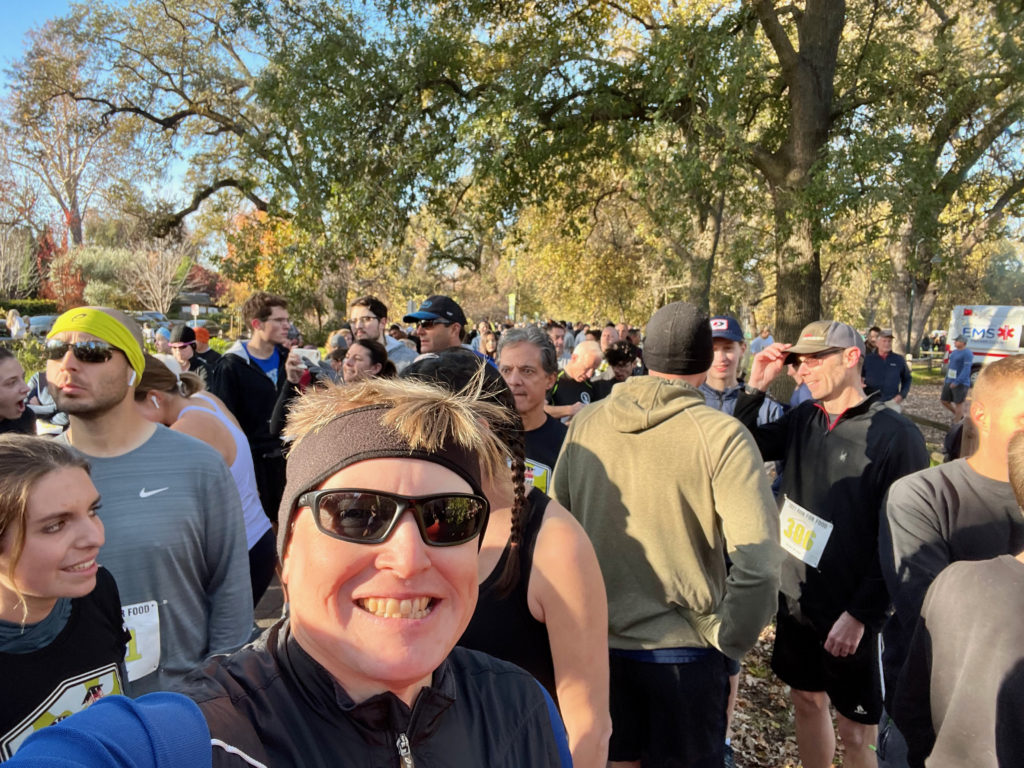
My at the starting line

My race nemesis, Ben Bailey, caught up to me with about half a mile to go. He then proceeded to pull away and there wasn't a damn thing I could do. I was going as fast as I could go and there was nothing in the tank.

Myself and Ben Bailey at the finish line, exhausted

What ruggedly handsome runners!

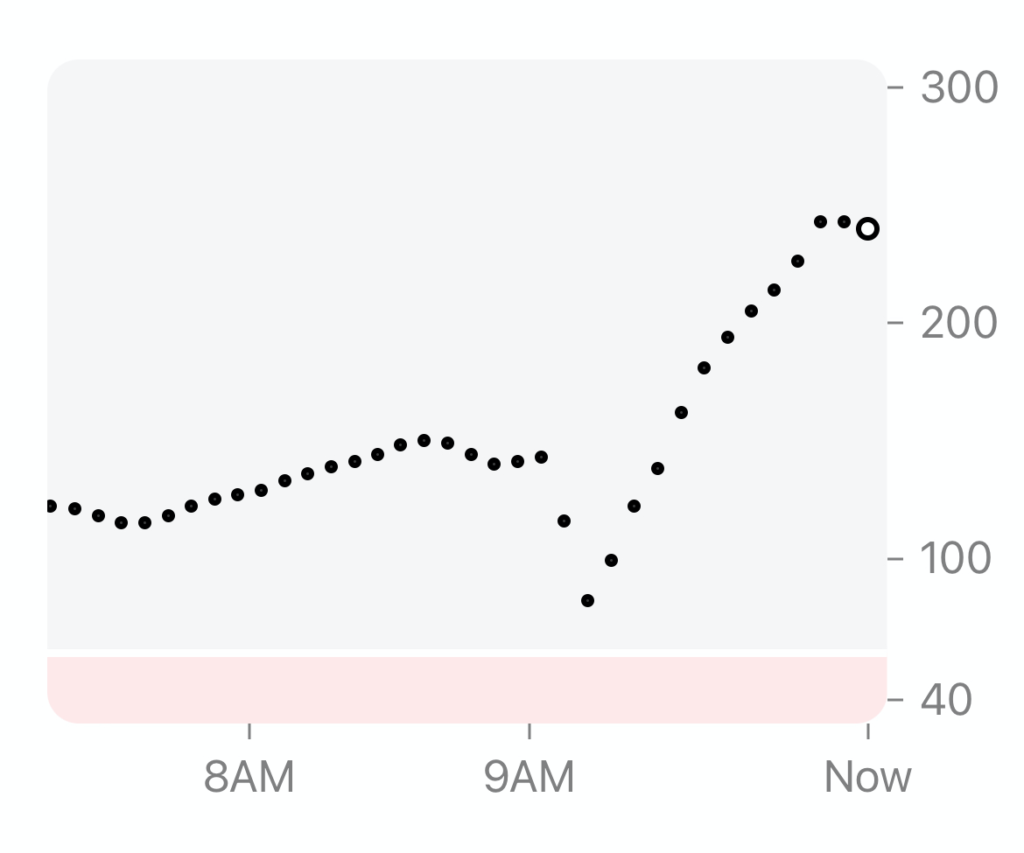
It was also a challenge on the blood sugar front. My Dexcom system gets a little cranky when it's cold out, so I knew the readings were to be taken with some skepticism. The precipitous drop you see below is almost certainly due to the cold impacting my sensor.

a graph of my continuous glucose monitor during my 5k race

Wheeeeeeee!

I knew the crazy spike was going to come when I stopped running as it happens after most workouts and seems to be proportional to my pace. I have to assume that running all out for 5k gets the liver a little revved up, dumping glucose (aka energy) into the blood stream because my muscles were screaming for fuel.