My Photo Backup Vortex

A photo backup vortex? What the heck is that?

I'm so glad you asked! Everybody should backup their important digital files. Luckily there are so many easy to use serives that it's trivial and inexpensive to backup everything, thus freeing you from having to decide what's "worthy" of being backed up. The default should be everything. But, what if some things were so important than you wanted more than one backup but still wanted everything to just get sucked into the "vortex" and off it went to however many backup systems you wanted? I consider my photos to be very, very important and I want them backed in multiple places.

This is the story of my photo backup vortex.

It starts with my iPhone. This is my camera at this point. I don't have any other DSLR or digital "point and shoot" (at least with a working battery) to take photos with any longer. I guess the best camera you have really is the one you have with you.

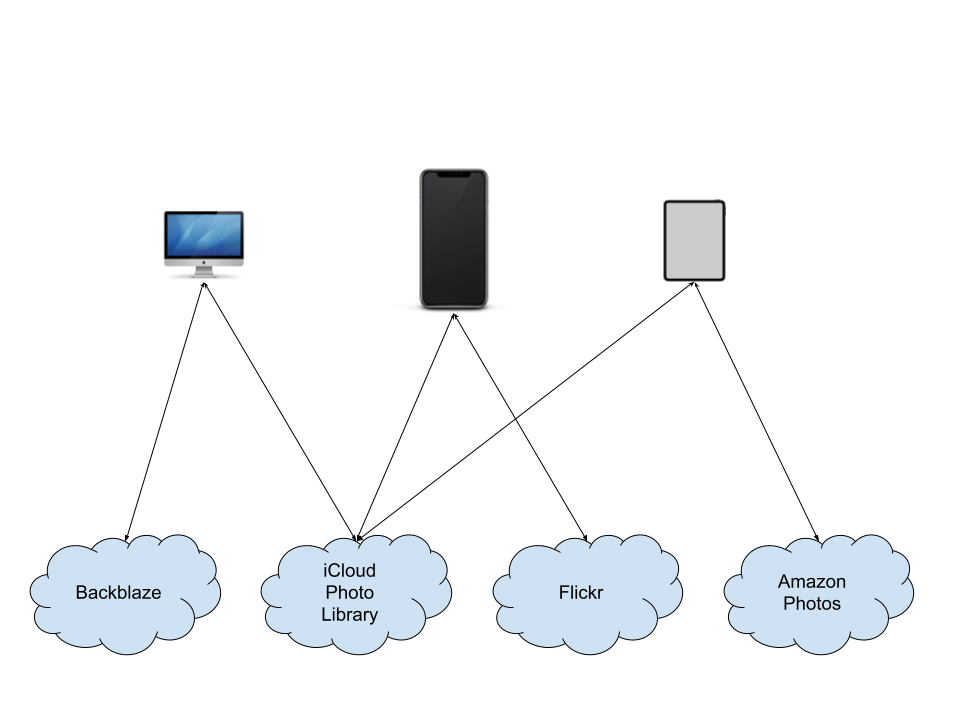
  1. Photos and videos taken on my iPhone get uploaded to iCloud Photo Library
  2. My iMac downloads full size copies of each photo and video
  3. My iMac is continually backing up to Backblaze
  4. My iPad is setup with Amazon Photos (free with Prime) and is continually uploading photos
  5. My iPhone is also set to upload to Flickr but...it's quite unreliable.

The key thing is that the vortex just sucks photos in and I don't have to do a thing. There's also local Time Machine backups on my iMac, but I just focused on add "offsite" cloud services. It's great to have local backups, but you really need to also have backups that don't live in the same house as your computer.

I don't really test doing a full restore from backup, or at least very often. Any time I get a new device (iPhone, iPad, Mac) it gets access to the canonical iCloud Photo Library and life is good. Backblaze would be the best restore to test out as it has a full copy of the library.

If you're a Google/Android person, you should just replace iCloud Photo Library with Google Photos.

An Ever Growing “Favorites” Playlist

I use Apple Music. You probably don't and that's awesome. I'm glad you're happy with the not Apple Music service that you're using. Anyways, Apple Music generates a number of playlists and they update them on a weekly basis. I wanted to somehow archive these. Adding a playlist every week seemed to not scale well and so I finally settled on using SongShift to dump the contents of the weekly playlist into a single playlist that would just continue to grow, but also not have any duplicate entries.

Luckily since SongShift is a pretty cool app, once you pay to unlock most of the power features (which I have no problem with!) you can easily fire stuff to multiple services. So, here's almost the same playlist on Spotify.

The Spotify playlist has a few more tracks because I was using SongShift to share things to Spotify before I came up with the above scheme.

A January of Long Runs

I do my "long" runs on Saturday. It's just how my schedule goes. A long run for me is 10 miles or longer. January in 2021 has five Saturdays, so I had five long runs. As you might imagine, running that distance takes a while, and if you're a data-driven, fitness tracker wearing nerd like myself, you know you score big points on these kinds of days. The kind of numbers that will screw up the average. More on that later, but first here's the first long run on January 2nd.

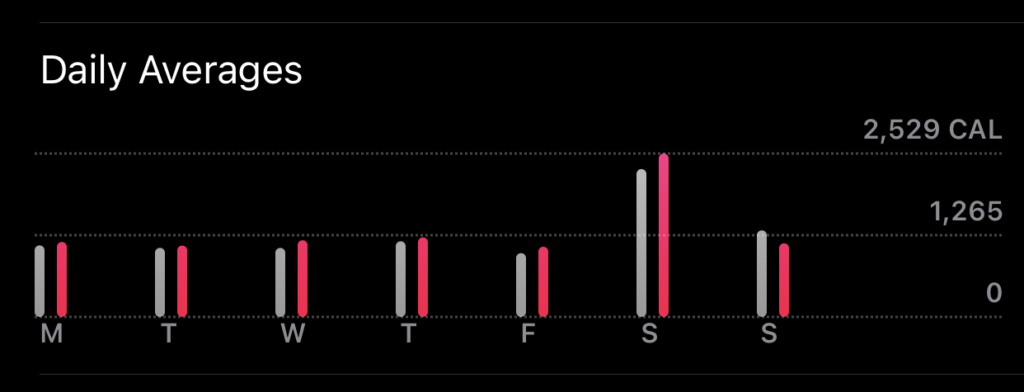
The idea of a daily average is probably fine for most people, but I would like a little more control. My average Tuesday is nowhere close to my average Saturday. I suspect the goal setting system in Apple Fitness, and probably many other competing products, use a daily average to create challenges. People on a training plan will likely have wildly different daily needs because in any plan there are "rest" days. It's not that you do nothing on these days, just that you do far less so that your body has time to recover and repair the muscle damage from your workouts.

These fitness systems we're using have all the data they need. It doesn't take a massive amount of machine learning. Apple Fitness even shows daily averages in the app. Right now it's tucked away in the Trends section. Who knows where it will be by the time you might be reading this.

A column chart showing my daily Move averages for the past year. Saturday stands out above the rest.

So why can't our devices give us better daily goals and instead treat every day the same? Again, maybe that's more than most people need, but it wouldn't it be a nice option with the added benefit (to the system maker) of showing how "smart" their systems can be?

I'm most familiar with Apple Fitness and my device is an Apple Watch (Series 5 for the moment). The system has evolved nicely over the years as they discovered the market for Apple Watch was primarily fitness. I'm hoping what I'm looking for is on their "roadmap" (a term I'm really learning to despise in the context of software development).

But what about that whole five Saturdays in January bit at the start? When you're looking at month over month (MoM) or Year over Year (YoY) comparison, if you're not taking into account that the composition of days in a month change from year to year, or that both the composition of days and number of days in a month change, your projections can suffer. January 2022 will still have five Saturdays and I'll likely do five long runs, but what about when there are only four Saturdays? That will a sizable impact. By then, I hope my fitness overlords have figured out how to generate realistic goals for me.

Observations on the 2020 NFL Regular Season

Overall:
Underdogs beat the spread 132 times (51.8%)
Favorites covered the spread 116 times (45.5%)
There were 7 pushes (2.7)
Last year was 136/113/7

Large Numbers:
The largest spread was 19.5 in week 8 and KC covered over the NYJ. Last year the NYJ were also part of the largest spread, but they covered last year.

The largest spread covered was 17, the NYJ covering against the LAR in week 15. J! E! T! S! Jets!

Common Numbers:
Again, the 3 point spread was the darling of Vegas with favorites covering 13 times and the underdog beating 16 times.

Odd Numbers:
The standout spread this year, for underdogs at least, was 3.5 where the underdogs beat 16 times and the favorites only managed to cover 8 times. Runner up was 6.5 points where this year the favorite covered 9 times to the underdogs beating 5 times.

Favorites:
A 3-way tie for first with Bal, Buf, and Sea all covering 9 times. KC was the worst at covering the spread, failing 8 times.

Underdogs:
NYG beat the spread 9 times, failing 5.
NYJ failed to beat the spread 10 times, but did manage to beat 6 times. J! E! T! S! Jets!

SF and...fuck those guys:
For the locals that care about "local" football, if you consider Vegas local now...

SF was 5 and 4 as the underdog and 2 and 5 as the favorite.
LV was 7 and 4 as the underdog and 2 and 3 as the favorite.

My Year in Music – 2020 Edition

Here’s a mostly chronological list of music I added to my collection in 2020. I did not limit this to music released in 2020. Since I use Apple Music and the “rest of the civilized world that cares about music app UI” uses Spotify, all album links are to Odesli, a service that will send you to your streaming service of choice, even if it’s Amazon Music. It used to be called Song.link, which is still the URL that I use to get there because I can spell both of those words and even remember to put the dot between them.

For some reason I’m still predisposed to add an entire album to my library and not just whatever song I heard that I liked. I still have this inextricable attachment to albums that doesn’t really matter with the rise of streaming. Perhaps this is why I finally broke down and bought a turntable…to force myself to listen to albums from start to finish. Maybe I’m hitting that age where I start to triple down on clinging to the past. Why not both?

Anyways, I’ve bolded the albums that I’ve enjoyed and listened to more than once this year. That’s not to say the other albums aren’t good, I just haven’t put in the same amount of time with them or maybe I really only liked one or two songs and the rest was meh. Who knows because if I don’t have time to listen, I certainly don’t have time to write reviews for them all. Also, there are already copious reviews by for more knowledgable folks than myself.

Music Albums That Mean Something To Me

These albums are (mostly?) just in alphabetical order. They represent things to me and mostly likely nothing to you. They are simply here as a list. Maybe someday I’ll write more about what they represent, but today is not that day. Tomorrow’s not looking too hot either.

Music Albums That Mean Something To Me

These albums are (mostly?) just in alphabetical order. They represent things to me and mostly likely nothing to you. They are simply here as a list. Maybe someday I’ll write more about what they represent, but today is not that day. Tomorrow’s not looking too hot either.

Observations on the 2019 NFL Regular Season

I thought I would be doing this every year, but I guess 2017 was the only previous year I managed to post something.

Anyways, I'm in a Yahoo! Fantasy Sports pickem league that uses the point spread. Each season I almost exclusively pick all underdogs and then I track everything in a messy, complex Google Sheet. Here are some trivia I pull out of that Sheet for the 2019 regualr season.

Overall:

  • Underdogs beat the spread 136 times (53.1%).
  • Favorites covered the spread 113 time (44.1%).
  • There were 7 pushes (2.7%).

Large Numbers:
The largest spread was 22.5 in week 3 and the New York Jets managed to "beat" that against the New England Patriots.

The largest spread covered was 21.5, Dal over Mia.

Common Numbers:
Surprising nobody, 3 points was the most common spread with favorites covering 20 times and the underdogs beating 17 times.

Odd Numbers:
A real standout number this year was the 6.5, where underdogs beat 16 times and the favorites only covered 3. I haven't seen anything like this in the 4 seasons that I've been keep track of this nonsense.

Favorites:
The Kansas City Chiefs and the New England Patriots tied, as favorites, covering the spread 9 times each. Kansas City failed 4 times, while New England racked up 7 failures. Those large spreads are tough.

The Los Angeles Chargers were by far, the worse favorite as they failed to cover 8 times and managed to cover a meager 2 games.

Underdogs:
The Arizona Cardinals, as an underdog, beat the spread 10 times, while failing 5, and pushing 1.

The Detroit Lions, as an underdog, failed to beat the spread 7 times, along with the Jaxonville Jaguars, the Miami Dolphins, the New York Giants, and the team from Washington DC.

Weekend Reading – 7/13/2019

Hi all,

I'm still trying to get back into the habit of publishing these. I'm not entirely sure of the format or the best place to publish. The last few emails are email-only with no web-facing version. That's probably not a good thing.

Web Stuff

Audio Stuff

Merch

From Ramadi to Better Blood Glucose

I typically have an easier time writing about things in the past because everything has been settled and it’s really just recounting the Five W’s with a few jokes. The areas where I struggle to write are when things are still in progress, for instance, home improvement. I’ve also been thinking about my health situation in this writing context and why it’s been a challenge.

To be blunt, I don’t really have a solid diagnosis, but it’s somewhere between Type 2 and Type 1 Diabetes. There are different names for what I’m most likely suffering from, Type 1.5 and cryptic Type 1 are the two most popular, that I’ve found anyways. No matter where on the Diabetes spectrum I actually am, there is one thing that needs to happen for me to prolong my lifespan and improve my health span, and that’s to control my blood sugar.

So what the hell does better blood sugar have to do with Ramadi? Well, this is one of the few times that I’ve been able to hold in my mind how I got from point A to point G, even though they’re unrelated, and I want to write it down…even though the story isn’t yet complete.

I’ll put the starting point at March 28th, 2019. This is when I attended the Spring Symposium for the Chico Executive Group. The main presentation was led by Echelon Front, a group of retired Navy SEALS that now do business consulting based on their founders book, Extreme Ownership. I would say nothing in the book is revolutionary, but they had to re-learn these lessons while getting shot at and then did us all a solid by writing them down with explanations on how they apply these principles of combat and leadership to situations where you might not be getting shot at, which are the ones I hope to limit my experiences. This group of SEALS were part of Task Unit Bruiser and were a big factor in The Battle of Ramadi and the Al Anbar Awakening and you can read all about it elsewhere if you want that backstory.

But their presentation at the CEG Spring Symposium led me down an interesting path, specifically and unexpectedly towards better blood sugar levels. As with a lot of good presentations, I get totally jazzed and start to immerse myself in the topic. I bought, and read (well, listened on Audible), Extreme Ownership. I subscribed to the Jocko Podcast and in one of the back catalog episodes I decided to listen to, Jocko mentioned Dr. Peter Attia. Then in another episode Attia was mentioned again and the name stuck, so I checked out his podcast and was immediately intrigued.

The Peter Attia Drive Podcast “is a weekly, ultra-deep-dive podcast focusing on maximizing health, longevity, critical thinking…and a few other things.” I’m interested in all these things, so I scrolled through the back catalog of that podcast and came across episode 41 with Jake Kushner, a pediatric endocrinologist and the topic was how to thrive with type 1 diabetes. Yes, please! I don’t want to live forever, but…you know. I’m in no rush to stop.

This episode is overflowing with great information and it’s been incredibly helpful, but we’re not done yet! Inside the episode they both talked about Dr. Richard Bernstein’s Diabetes Solution book. Combined with the Jake Kushner information and this “solution” in book form, I have been able to dramatically improve my blood sugar levels, better understand what is impacting my blood sugar levels, and how to better utilize insulin and exercise.

What is “better”? Better is having normal blood sugar levels (Bernstein recommends trying to aim for 85 mgdL, but 79 to 110 mgdL is generally accepted), with low variances between lows and highs, without having to rely too much (this varies greatly depending on how hosed the Beta cells in your pancreas are) on exogenous insulin. It turns out that just injecting a ton of insulin to cover eating crappy food (read: high in carbohydrates and/or sugar) is not a winning strategy. Who knew?! I could go into all the details, but the book is a much better read than anything I could give you.

As an aside I’ve yet to see an endocrinologist myself because the waiting list is about three months. Because we have the best health care system on the planet. Or so I’m told. So, at least now I feel that while I wait I’m doing less damage to myself.

So, that’s the path from the Battle of Ramadi to my “better” blood glucose values. It’s been fun learning new things at every step of the way and discovering unexpected paths leading to better outcomes.