Cleaning Up The RideHome Archive

I listen to the RideHome podcast every weekday, and some weekends when there are bonus episodes that pique my interest. Around November 24, 2018 I think I started hearing Brian, the host, say things like “I’m sure I’ve talked about this before” and thought to myself that this should be a pretty easy problem to solve. Well, if it’s easy it wasn’t easy for me. But that rarely stops me from trying…

I hacked together some really terrible python to grab the RSS feed, parse it, extract the links, and spit out Markdown. Why Markdown when you already had HTML? I was going to use GitHub Pages and Markdown was the easiest path to that, that I knew of at the time. What I didn’t know was that Markdown was going to become the format of choice for LLMs. Anyways, once I got my hack-a-thon scripts working, I basically just ran them once in a while to update my Markdown files and push everything to GitHub for hosting. It mostly worked most of the time, except when the human making the show notes would change how they did the markup. Silly humans, always ruining everything with their capriciousness.

Now, fast forward to December 8, 2025 and I drop a big “Claude Rework” into the repository. Yes, as regular readers know, I’ve been using Claude Code for my little one-off personal projects. What really helped though was Nick Tune’s claude-skillz. I used the TDD persona and refactored my crappy scripts all the way to the point where I could start asking Claude Code to make new features. What kind of new features? Well, I had always wanted to do some data analysis, but I was always too busy and then…this made it so easy. I made a Wrapped feature for 2025 and then ran it against all the previous data I had gathered.

At work I have a reputation as an “AI Hater”, which if you only want to characterize “AI” as “will replace all humans and reduce human labor dollars to zero”, then yes…that’s accurate. I use Claude, ChatGPT, and Gemini almost every day for something. Sometimes I’m just testing the same question across models. Sometimes I’m having them all independently evaluate something I’ve written, always with the prompt that the model is my intended audience and to ask me questions about what I’ve written to help me find the gaps I’ve left or where I was unclear. Seriously, they’re really good at this…if you can ignore the sycophancy.

So what? Now I have some python that’s less sucky than when I started…big deal. Well, sure…but for me it’s more about finding where the actual value can be derived. Is it worth it to back the systems that are actively trying to replace me and the ridiculous race to turn the planet into either energy plants or data centers to consume that energy? Ask again later, hopefully we and the planet are around long enough for that. Right now, for me…my little project is in a much better state and I can do things that I probably wouldn’t have done on my own. Maybe that’s enough.

EV Data Update

A few years ago, Kat got a Volkswagen ID.4. It’s our first electric vehicle of any kind. With the purchase came three years of free charing from Electrify America. Fun fact, Volkswagen created Electrify America as part of their settlement with the EPA around Dieselgate.

The CAA 2.0 liter partial settlement requires Volkswagen to invest $2 billion in ZEV charging infrastructure and in the promotion of ZEVs.  The ZEV investments required by the CAA 2.0 liter partial settlement are intended to address the fact that consumers purchased these illegal vehicles under the mistaken belief that such vehicles were lower-emitting than others. Electrify America, LLC, was created by Volkswagen Group of America to implement this requirement.

But, that’s not why I bothered starting to write today. Today we’re going to run some numbers!

In the three years that we had free charging:

  • 6388.43 kWh
  • 176 charging sessions
  • 25,854 miles driven

This, on average, gets us 144.44 miles per charge and about 4mi/kWh. If we had paid for this, assuming an average price of $0.50/kWh, that would be about $3,200. Not bad. Please keep in mind these numbers are all based on averages and some charges got fewer miles due to average speed (going fast is bad for EV mileage as well) , temperature (too hot is bad, too cold is bad), and did we do more uphill then downhill (going uphill is hard, thanks a lot, Gravity). On that last you you can reasonably argue that it all buffs out as we eventually return home, so we did as much downhill as uphill.

At the end of the day it costs, ignoring everything but electricity, $0.14/mi to use the ID.4. In comparison, my GTI costs $0.17/mi.

The 2023 NFL Betting Spread

Overall

Underdogs beat the spread 126 times (46.3%)
Favorites covered the spread 140 times (51.5%)
There were 6 pushes (2.2%)
Last year was 144/118/9

A pie chart showing the percentage of favorites versus underdogs.

This is a pretty big swing from last season, where the underdogs beat 53.1% of the time.

Large Numbers

The largest spread this year was 16.5 in the Week 10 matchup between Dallas and the New York Giants. Dallas covered that spread. Dallas had the highest spread in 2022 as well.

Common Numbers

The 3 point spread roars back into top pick of Vegas and went 27-16 to the favorites. The adjacent spreads of 2.5 and 3.5 went 18-17 and 14-14 respectively.

Odd Numbers

Let’s face it, the underdogs had a rough year, but the one bright spot was at 5.5 where they managed a 13-9 showing. Well done, all you 5.5 underdogs! The 8.5 spread also had a 6-2 for the underdogs and the 7 spread was 7-3 for the favorites. Again…rough year to be the underdog.

Favorites

This won’t console any 49er fans, but they were favored in every single regular season game and covered the spread 11 times to take the crown. Dallas and Detroit tied for second with 10 covers as favorites.

Buffalo and Green Bay tied at 8 for failing to cover the spread. But what, where’s KC because we know they suck at beating the spread as favorites! They failed to cover 7 times, so…they were in the running and they were favorites 16 times. Woof.

Underdogs

Arizona, Chicago, and NYG tied for first at beating the spread as underdogs with 8 a piece.

Carolina, last years darling at beating the spread as an underdog, failed to cover 11 times. Ouch. The closest teams were Arizona and Tennessee with 9 failures. Yes, Arizona was the underdog for every regular season game, good catch.

2023 Books

I consume the majority of my books through audio, specifically Audible, some through Kindle, and then some dead tree versions. Don’t @ me, it’s what I do and if you don’t and use something else, that’s awesome. I’m truly happy for you.

So, here’s my 2023 books by medium.

Audible

Roadkill by Dennis E. Taylor. I didn’t finish it. In fact, I don’t think I get more than 50 “pages” in before giving up. I don’t know why, it just…didn’t work out.

The Hard Thing About Hard Things by Ben Horowitz. Didn’t finish.

Buy-In by John P. Jitter, Lorne A. Whitehead. A really good, short read on how to not have your good idea killed by other people.

Elantris by Brandon Sanderson. It was…fine. Fantasy isn’t my favorite genre, but I stuck with this one.

The Caledonian Gambit by Dan Moren. Didn’t finish.

SpecOps by Craig Alanson. An interesting sci-fi novel but I think the narrator isn’t my favorite.

Wool by Hugh Howey. I read this because I watched Silo. I think I live the TV version more, but I appreciate how much more detail the book was able to give. I don’t think I read the rest though.

Quit by Annie Duke. A solid advice book.

Slow Time Between Stars by John Scalzi. It’s just a short story, but I instabuy anything from Mr. Scalzi.

The Crux by Richard P. Rumelt. The follow-up to his quintessential book on strategy and well worth the read.

Four Thousand Weeks by Oliver Burkeman. You have a finite time to live, what are you doing with that time?

Paradise by Craig Alanson. The third book in his series. Haven’t finished it yet. Again, probably the narrator.

Starter Villain by John Scalzi. Absolutely hilarious, but again, I’ll buy anything from Scalzi.

Product Roadmaps Relaunched by C. Todd Lombardo, Bruce McCarthy, Evan Ryan, and Michael Connors. This book is fantastic and if you have to create roadmaps for software teams or projects, this is a must-read.

Wiring the Winning Organization by Gene Kim, Steve Spear. Even if you aren’t a manager, this is well worth the read and it’s based on a ton of research.

The Three Body Problem by Cixin Liu. Still reading, hoping for good things.

Switch by Dan and Chip Heath. All about the science of changing behavior.

Kindle/Dead Tree

Product Operations by Melissa Perri, Denise Tilles. Haven’t started yet.

Tidy First? By Kent Beck. Haven’t started yet.

Implementing Service Level Objectives by Alex Hidalgo. Haven’t started yet.

Extreme Programming Explained by Kent Beck and Cynthia Andres. A good read, but also easy to put down when distracted.

The 2022 NFL Betting Spread

Overall

Underdogs beat the spread 144 times (53.1%)
Favorites covered the spread 118 times (43.5%)
There were 9 pushes (3.3%)
Last year was 140/130/2

Large Numbers

The largest spread this year was 17 in the Week 14 matchup between Dallas and Houston. Houston covered. Oddly enough Houston was favored by 17.5 over Arizona last season. Arizona covered.

Common Numbers

The 2.5 point spread retains its first place status, barely, and went 19-15 to the favorites. The 3 point spread went 17-16 for the favorites. The 4 point spread went 8-7 for the favorites. 7 landed at 10-9 for the underdogs.

Odd Numbers

Between 4.5 and 6.5 it went all to the underdogs. 1.5 came in at 8-6 for the underdogs as well.

Favorites

The crown this year goes to Cincinnati with an 11-3 record. For those keeping score at home that’s the same score Dallas ended with. San Francisco was 11-5.

Kansas still sucks against the spread as a favorite at 5-9. Baltimore, Green Bay, Philly, and Tampa Bay all failed to cover 8 times each as favorites. Buffalo and Denver each failed 7 times.

Underdogs

Carolina was money against the spread, beating 10 times and failing only 4 as underdogs. Detroit and New York Giants both delivered 9 beats as underdogs.

Chicago, Houston, and LA Rams all failed to cover 8 times. In defense of Houston, they did beat the spread 8 times. They were underdogs in every single game. 🤣

The 2021 NFL Betting Spread

Once again I've compiled the season into this quaint little overview. Maybe someday this will be replaced with GPT3, or GTP4, but for now it's still handcrafted.

Overall:

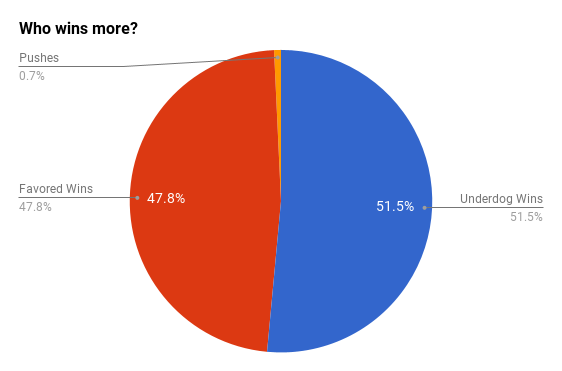
Underdogs beat the spread 140 times (51.5%)
Favorites covered the spread 130 times (47.8%)
There were 2 pushes (0.7%)
Last year was 132/116/7

A pie chart that shows the betting spread is really close to 50/50

Large Numbers:

The largest spread was 17.5 in week 7, Arizona vs Houston, which Arizona covered 31-5. This breaks the NY Jets two year streak of being involved in the largest spread.

Common Numbers:

Jumping from second to first in the race for most common spread was 2.5, narrowly edging out 3 this season, 30-29. Unsurprisingly the 3 point spread was a dead heat with favorites covering 15 times and underdogs beating 14 times. Now, 2.5 got weird with only 9 favorites covering and 21 underdogs beating the spread. As they kids say these days…daaaaaaaaang.

Odd Numbers:

So 2.5 should get mentioned here, but I already gave you the details. Next up is 5.5 with 2 favorites covering and 9 underdogs beating the spread. A single point saw 9 favorites cover and only 4 underdogs beat. 10.5 was 8 favorites covering and only 3 underdogs beating the spread.

Favorites:

Coming from seemingly out of nowhere, Dallas took the crown with an 11-3 record at covering the spread. Way to go, Big D! KC slightly reversed their situation from last season (5-8 as favorites) with a 9-8 record when favored.

Baltimore was our top loser, failing to cover 9 times. Nine times… Cleveland, KC, and Tampa Bay all tied with 8 failures in this category.

Underdogs:

Detroit, a not very good football team, managed to beat the spread 10 times this season, but failed 7 times. Yes, that means they were never favored in a single game. This should shock nobody. Pittsburgh was 8-4 beating the spread.

Jacksonville had a very, very hard time beating the spread, going 5-10. Chicago, Houston, NY Giants, NY Jets, and the Washington WTF’s all tied with 9 failures to beat the spread.

iPhone Photo Breakdown

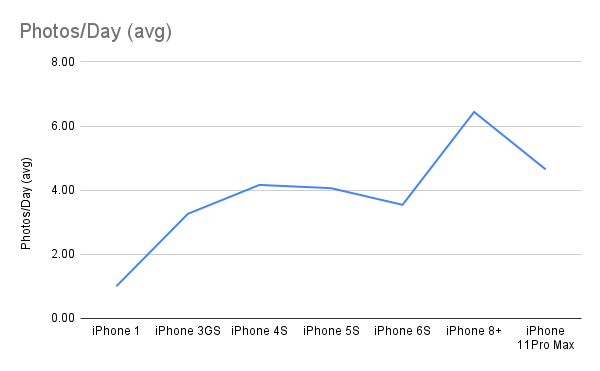
Since January 15, 2008 I've taken 18,784 photos with 7 different iPhone models.

  • iPhone 1 (1,486 over 1,482 days)
  • iPhone 3GS (2,186 over 670 days)
  • iPhone 4S (3,344 over 803 days)
  • iPhone 5S (3,051 over 751 days)
  • iPhone 6S (3,913 1,104 days)
  • iPhone 8+ (4,804 over 746 days)
  • iPhone 11 Pro Max (3,091 over 664 days [as of 08-07-21] and counting)

Generally I've taken more photos with each successive iPhone model, with a little lull at 5S and 6S. The 11 Pro Max is probably going to come in lower just due to COVID. We haven't travelled hardly at all and that tends to be when I add a good number of photos to the collection.

Graph showing that I generally take more iPhone photos as time goes on

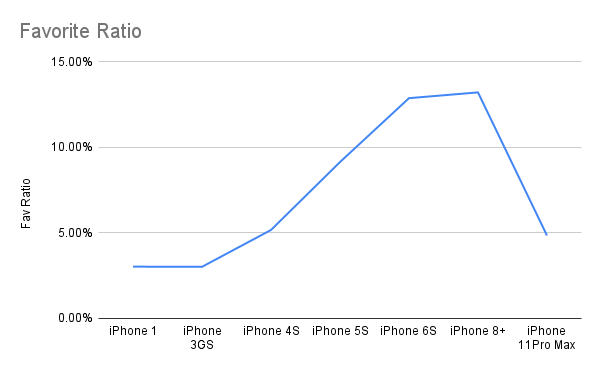
I'm not sure if I think I've become a better photographer or if the camera technology just generates better photos, but over time the number of favorites has increased. Again, the 11 Pro Max is a COVID outlier.

Graph showing that I generally favorite more photos as time goes on

Not exactly riveting data analysis, but the air quality is crap today so I was stuck inside and this is all I could think up.

Update: Based on some feedback I have corrected the number formating and added the number of days I had each phone.

Amazon Order History

Amazon provides an Order History Export function and it will give you everything back to 2006 in a CSV download. I dumped that into a Google Sheet, did a quick pivot table to get orders by year...just because.

A graph showing that my Amazon order count has increased over time

Now, a few caveats...

  1. This is only orders on my account, not our total household orders.
  2. I would haven't to manually enter orders prior to 2006 and I'm pretty lazy, so that probably won't happen.
  3. I don't know why our orders exploded in 2011. I should probably look up some kind of Amazon Prime timeline to see what launched.
  4. I don't know what happened in 2017.

Observations on the 2020 NFL Regular Season

Overall:
Underdogs beat the spread 132 times (51.8%)
Favorites covered the spread 116 times (45.5%)
There were 7 pushes (2.7)
Last year was 136/113/7

Large Numbers:
The largest spread was 19.5 in week 8 and KC covered over the NYJ. Last year the NYJ were also part of the largest spread, but they covered last year.

The largest spread covered was 17, the NYJ covering against the LAR in week 15. J! E! T! S! Jets!

Common Numbers:
Again, the 3 point spread was the darling of Vegas with favorites covering 13 times and the underdog beating 16 times.

Odd Numbers:
The standout spread this year, for underdogs at least, was 3.5 where the underdogs beat 16 times and the favorites only managed to cover 8 times. Runner up was 6.5 points where this year the favorite covered 9 times to the underdogs beating 5 times.

Favorites:
A 3-way tie for first with Bal, Buf, and Sea all covering 9 times. KC was the worst at covering the spread, failing 8 times.

Underdogs:
NYG beat the spread 9 times, failing 5.
NYJ failed to beat the spread 10 times, but did manage to beat 6 times. J! E! T! S! Jets!

SF and...fuck those guys:
For the locals that care about "local" football, if you consider Vegas local now...

SF was 5 and 4 as the underdog and 2 and 5 as the favorite.
LV was 7 and 4 as the underdog and 2 and 3 as the favorite.